
The Three Graces
APOKALUPSIS
The Three Graces – Making of a Sculpture
While discussing his vision of a sculptural interpretation of his mural Apokalupsis with project director Anne Brown, artist Joseph Sulkowski discovered they had a mutual friend, Diana Reuter-Twining, one of the foremost female sculptors in the country. A prolific animalier artist with a Masters in Architecture, who also studied at the Corcoran School of Art, Loveland Academy of Art, and the Scottsdale Artists’ School, Diana is known for both her small- and large-scale sculptures, many in bronze with beautiful patinas.
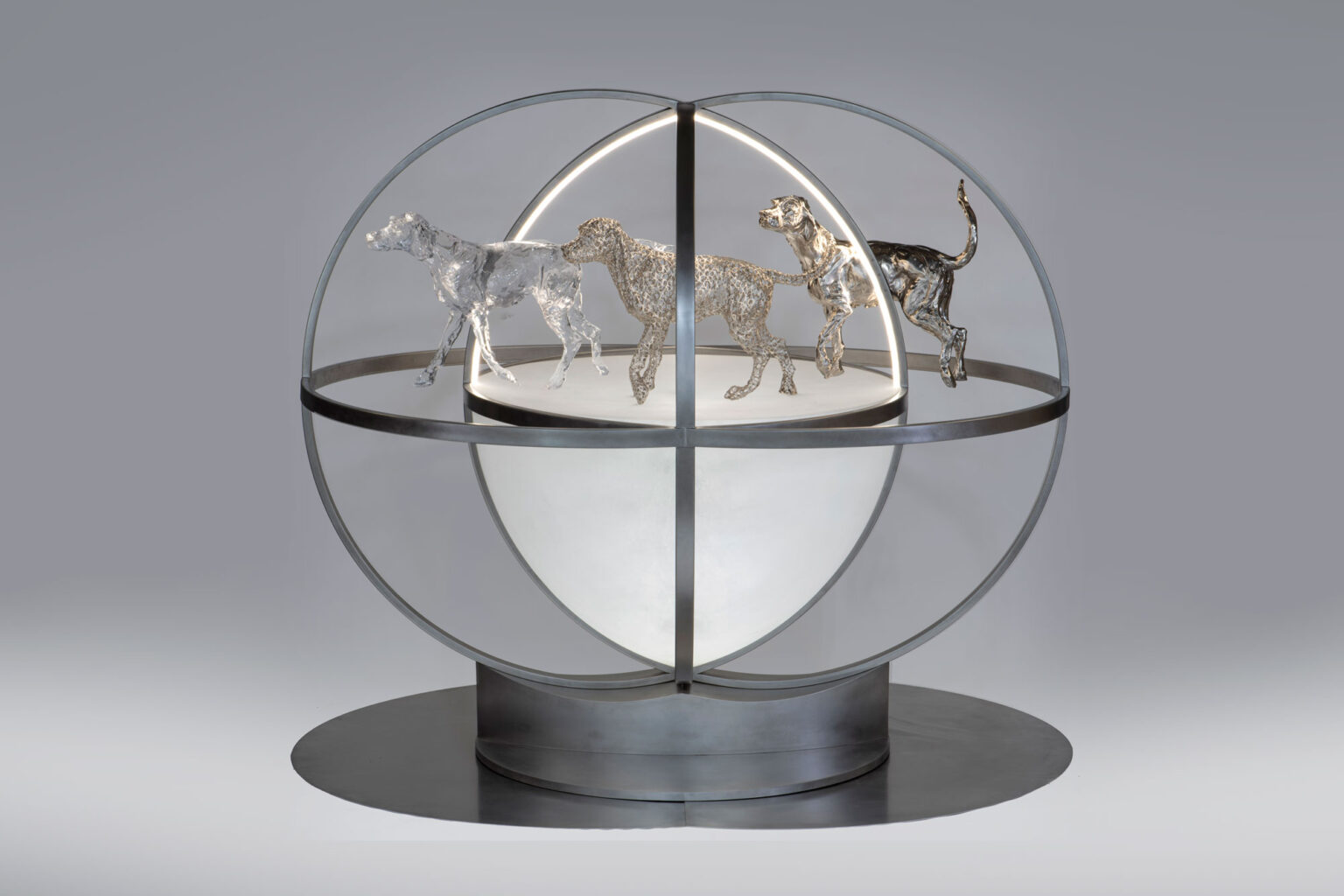
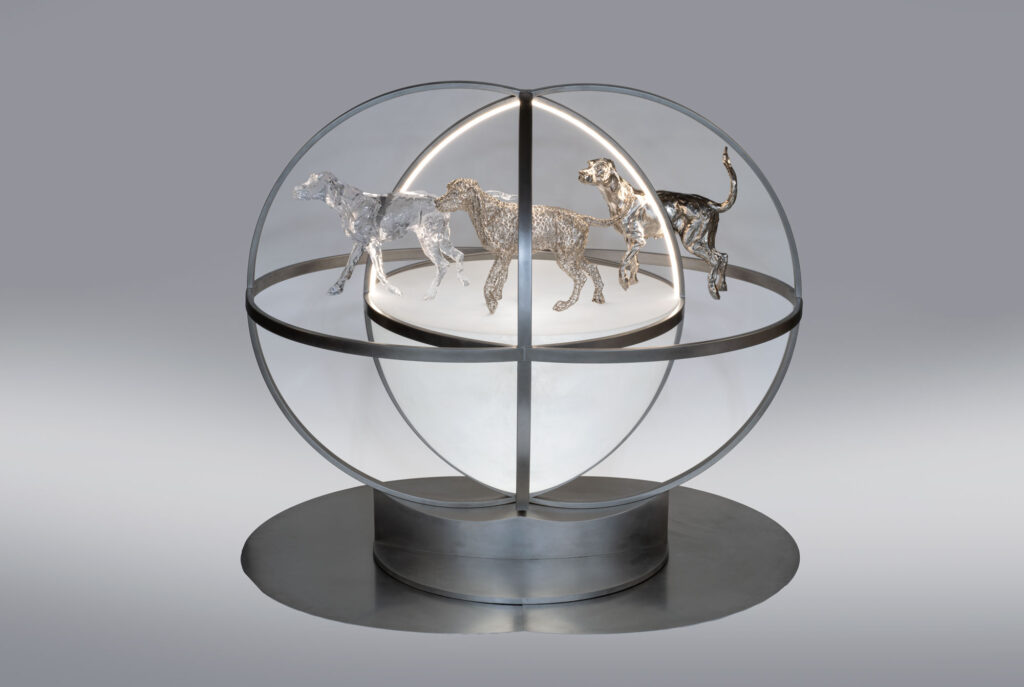
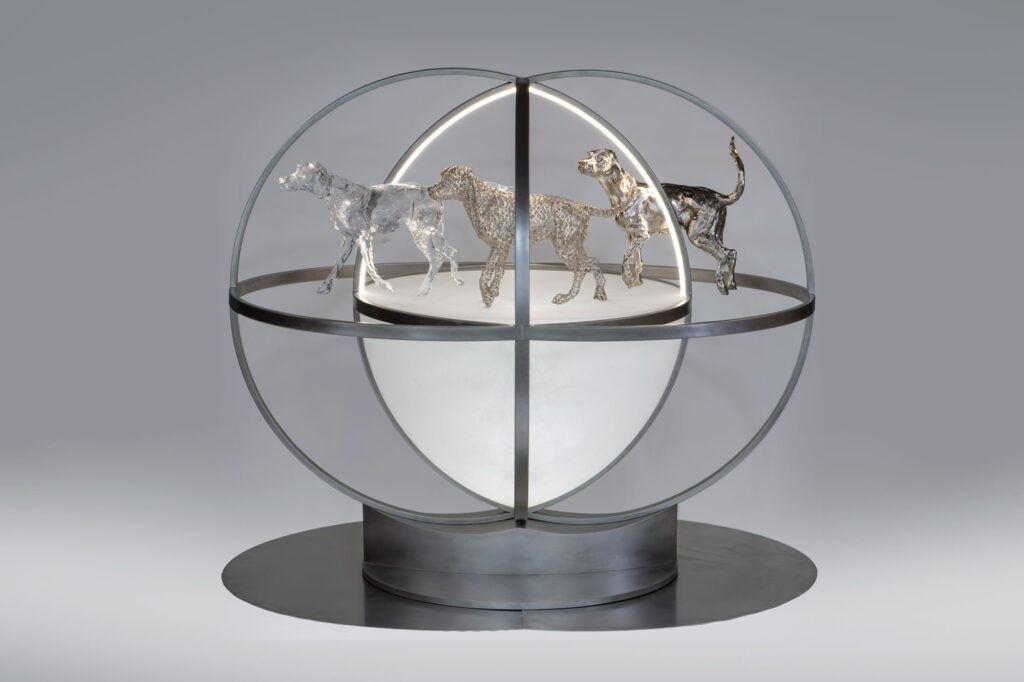
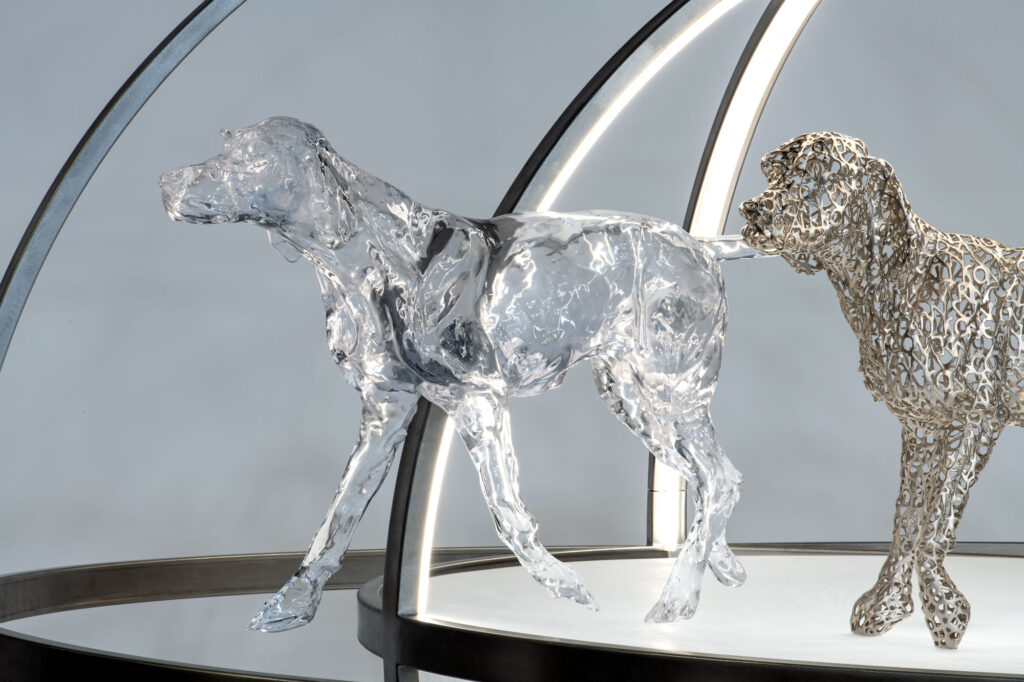
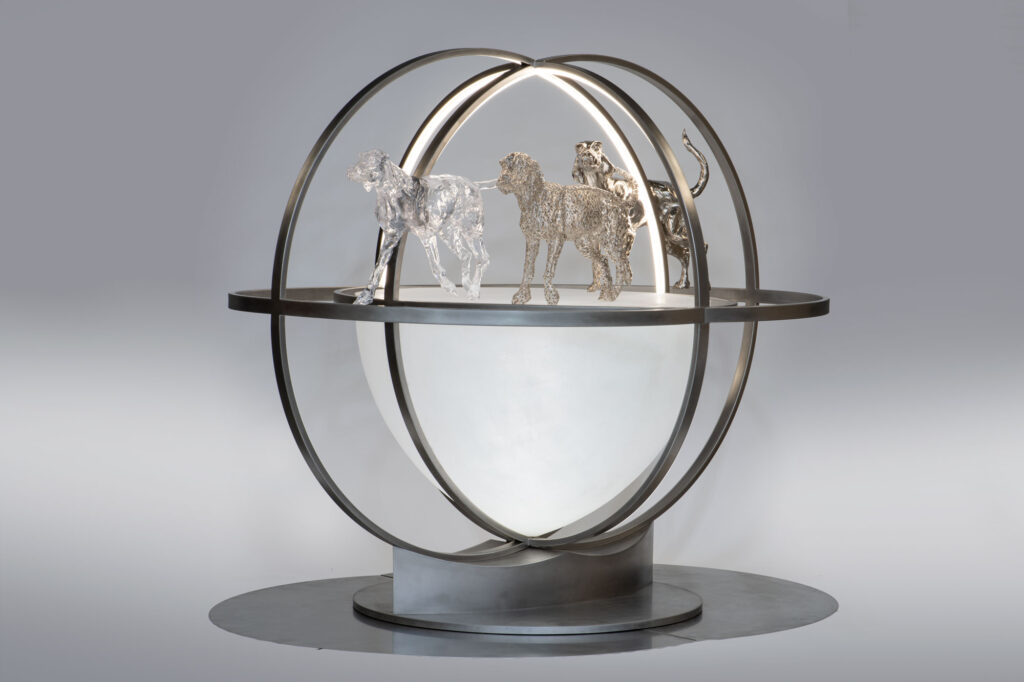
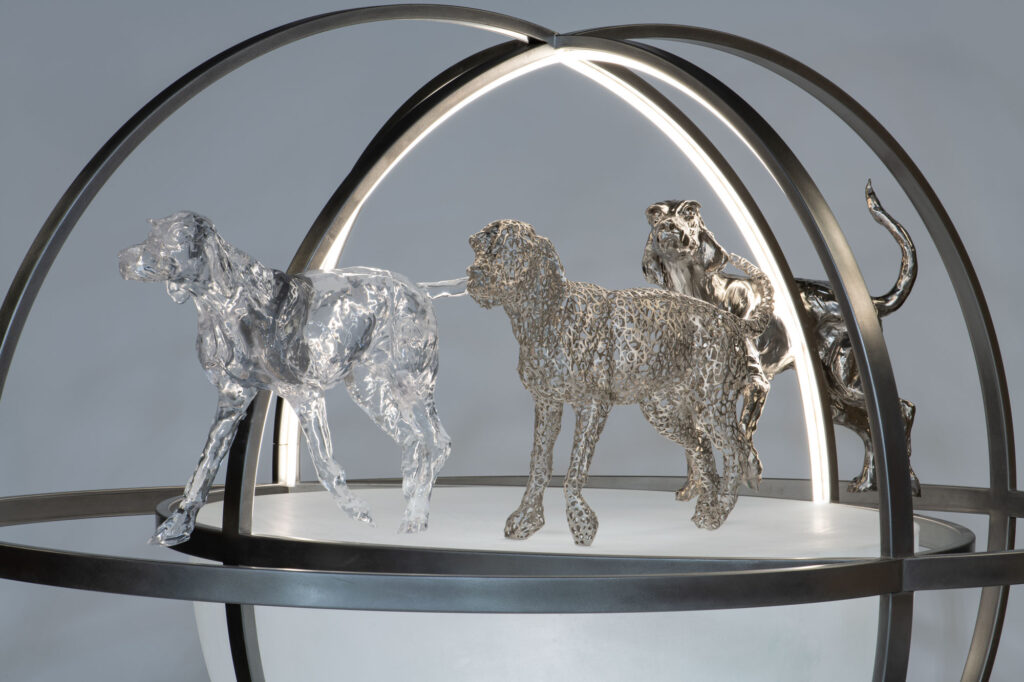
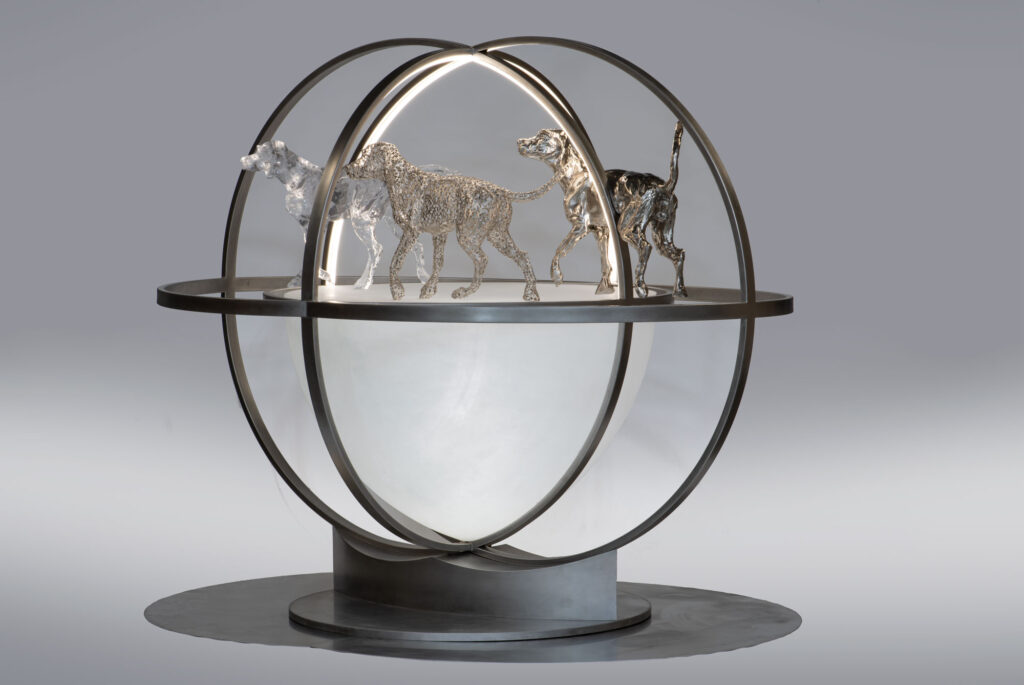
Joseph’s concept of the three-dimensional The Three Graces is based on the three hounds that are the focal point of his large-scale composition. “Using elements of sacred geometry, I constructed the space out of which the three figures are symbolically moving from a state of being in time and space, to one of transcendence and transfiguration,” he explains.
Anne enthusiastically suggested he and Diana collaborate on creating the sculpture, and Joseph was immediately captivated by the idea. Without any preconceived ideas of what such a collaboration might look like, and open to all the possibilities, he contacted Diana and presented the concept to her.
“I met Joseph’s work long before I met Joseph,” says Diana. “I walked into the Halcyon Gallery in London, in the late 1990s, and can still remember his ink sketch of a lioness walking through a Venetian red wash.” She says “walking through” and not “on” because “his painting took me into a 3-D world which, as a sculptor, I find both haunting and compelling.”
Diana was very receptive to the idea and they instantly began talking in earnest about how this could come together. “We both knew we didn’t want the sculpture to be merely a detailed rendering of dogs, but rather a work of art expressive of the essence that the three hounds symbolically represent: Love, Beauty and Joy. Each hound’s pose would be based upon those in my allegorical mural.”
Says Diana, “With humility, Joseph – who had done no sculpture since art school 50 years ago – approached me to introduce him to the process of sculpting.” She explains that the logistics of working on any sculpture “is really what drives the project and working on the The Three Graces didn’t disappoint!” They quickly agreed that, working from her farm in Virginia where she has her studio, gallery and guest quarters in a renovated 19th-century barn, Diana would do clay mockups of the three hounds for his review, Joseph initially thought the figures should be sculpted life-size. “However, I took Diana’s lead on this when she suggested a much better, more effective plan to implement.” Based on her extensive knowledge and experience as a master sculptor, they decided that the initial mock-ups would be one-fifth scale. “By determining the structure and scale of a sculpture, and leaving out superfluous details, I am able to work quickly through options, similar to how one sketches an idea in architecture,” says Diana.
Each hound would have its own sculpture stand, allowing Diana to manipulate them individually in relationship to the composition, while referring to the open pages in her reference books on the musculature and skeletal systems of any animal she’s sculpting.
Once Diana had prepared the armatures and formed the clay figures, Joseph and his wife, Elizabeth, made the journey to her beautiful studio in March 2021.
“We immediately went to work. My primary focus was to manually twist and bend the clay figures into the gestures as I had expressed them in paint on canvas,” he says. Joseph had not worked with oil-based clay before, “and was the perfect student; he soon learned that all you need is a sharp knife, some smaller tools, and a microwave to take ideas to a more developed stage,” describes Diana, whose work has appeared in numerous exhibitions, including at the National Museum of Wildlife Art, the Society of Animal Artists, and the National Sculpture Society.
Joseph found clay surprisingly malleable, making it easy to physically work them into the rhythms and dynamic symmetry necessary to bring each of the hounds to life.
The sculptor and artist worked quickly and seamlessly together, constantly referencing a photograph of his painting, brainstorming for two days through hundreds of options to achieve the effects they wanted to create, all while manipulating tools and working their fingers into and over the clay. “It was exciting to see our creative efforts take shape. Creating art requires all of the mental, physical and emotional commitment of the artist,” says Joseph. Each session left them exhausted, depleted even, but “very satisfied with the results,” adds Diana.
“Gesture kept coming back as the most important aspect of this Schematic Design phase,” says Diana. At dinner, they reflected on their progress and options at hand, and continued work the next day.
Although the figures were very close to completion, it was decided to let the work rest so both artist and sculptor could reflect upon what had been achieved thus far. Joseph returned three months later, for their third and final session.
“At this stage, we let the sculpture ‘speak’ to us as to how it wanted to finish itself. This is the part of the creative process where art is actually made,” describes Joseph. Adds Diana, “We were both able to look at the sculptures with fresh eyes. With more confidence through experience, Joseph used his hands almost as he would use a paint brush, to manipulate lines that mimicked what he had chosen to express in his painting.”
Pleased and satisfied with their finished work, they carefully loaded the trio of hound sculptures into the back of Diana’s SUV and headed to Baltimore to meet at the office/workshop/thinktank of Harry Abramson of Direct Dimensions, “the next exciting stage in our sculpture’s realization,” recounts Joseph. Diana says Joseph “understands and is committed to his responsibility as an artist to literally pull you into his work, and in doing so is able to hold you in conversation with it.”
Direct Dimensions’ engineers and 3-D artists work with clients from the industrial, governmental and scientific world; they also make space and time to share their talents and knowledge in helping artists fabricate their ideas in 3-D as sculptural works of art. In many cases, these projects are on a grand scale. They are also digitally scanned for preservation.
“The obvious difference between painting and sculpture, of course, is the third dimension. What works in two dimensions doesn’t always in three,” says Joseph. “Harry understands that you have to constantly walk around the piece to see how an adjustment on one side effects the whole. He speaks the language of art as well as that of the fabricator and technician,” says Joseph who appreciated both Harry’s creative ideas and his role as the project manager in the production process.
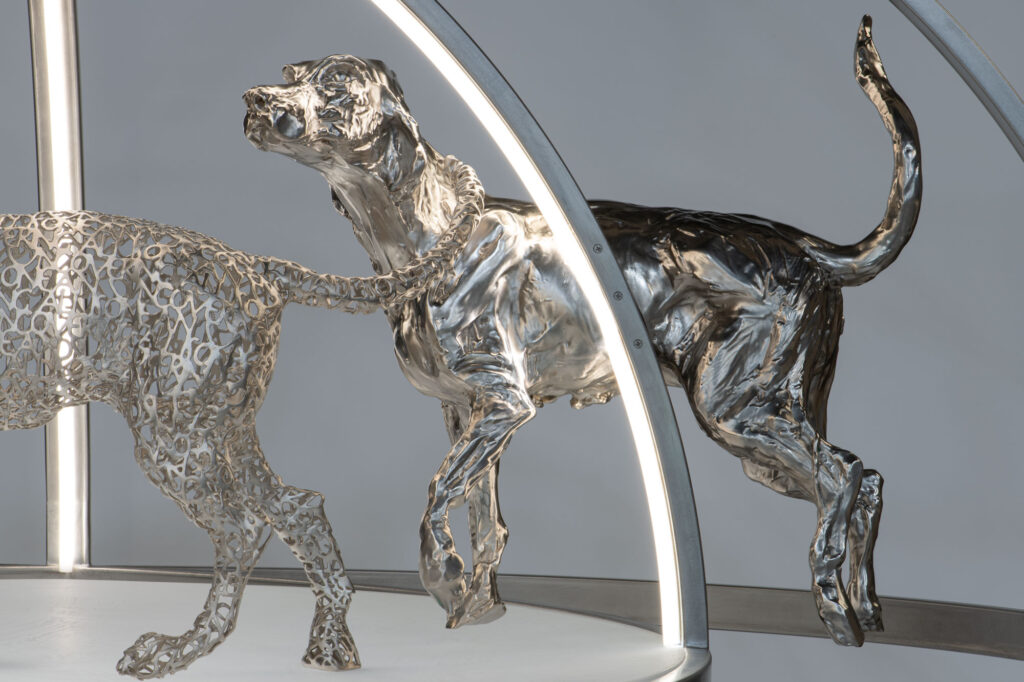
At the white board in Harry’s office, Joseph began drawing the intersecting circles of the dyad, and the construction of the sacred vesica piscis, “which is the space or portal out of which the eternal enters the field of time,” explains Joseph. “I asked Harry how and if we could create these intersecting circles in three dimensions with the hounds walking through them. I also wanted to create different textures and finishes to each of the hounds in a way that would symbolize their transformation from the earthly reality of the physical to the transparent state of transcendence.”
“Once we understood that the support drove the design, we were able to follow that geometry to a conclusion,” says Diana. They found that the egg-shaped vessel that acts as a support or base allows the three circles to intersect in such a way that the artists can show, through a material change, how the hounds are physically transformed as they pass through the spheres into a deeper consciousness.
They addressed issues such as portability, weight, lighting and the electronic specifications, as well as the pros and cons of different materials – glass, stainless steel, fused aluminum, and bronze. “We left Harry knowing our sculpture was in the final stages of design development and that the construction documents would now drive the project,” Diana concludes.
“Having the opportunity to work with Joseph on the sculptures that accompany the Apokalupsis project was a pivotal moment for me in my career,” says Diana. Of Harry, Joseph says “he has brought our sculpture to life in a way and at a scale that makes it a masterwork in its own right.”
The combined efforts of Joseph, Diana and Harry have resulted in The Three Graces, an unforgettable piece of artwork that embodies a symbolic three-dimensional representation of Love, Beauty, and Joy moving through time and space towards transcendence.